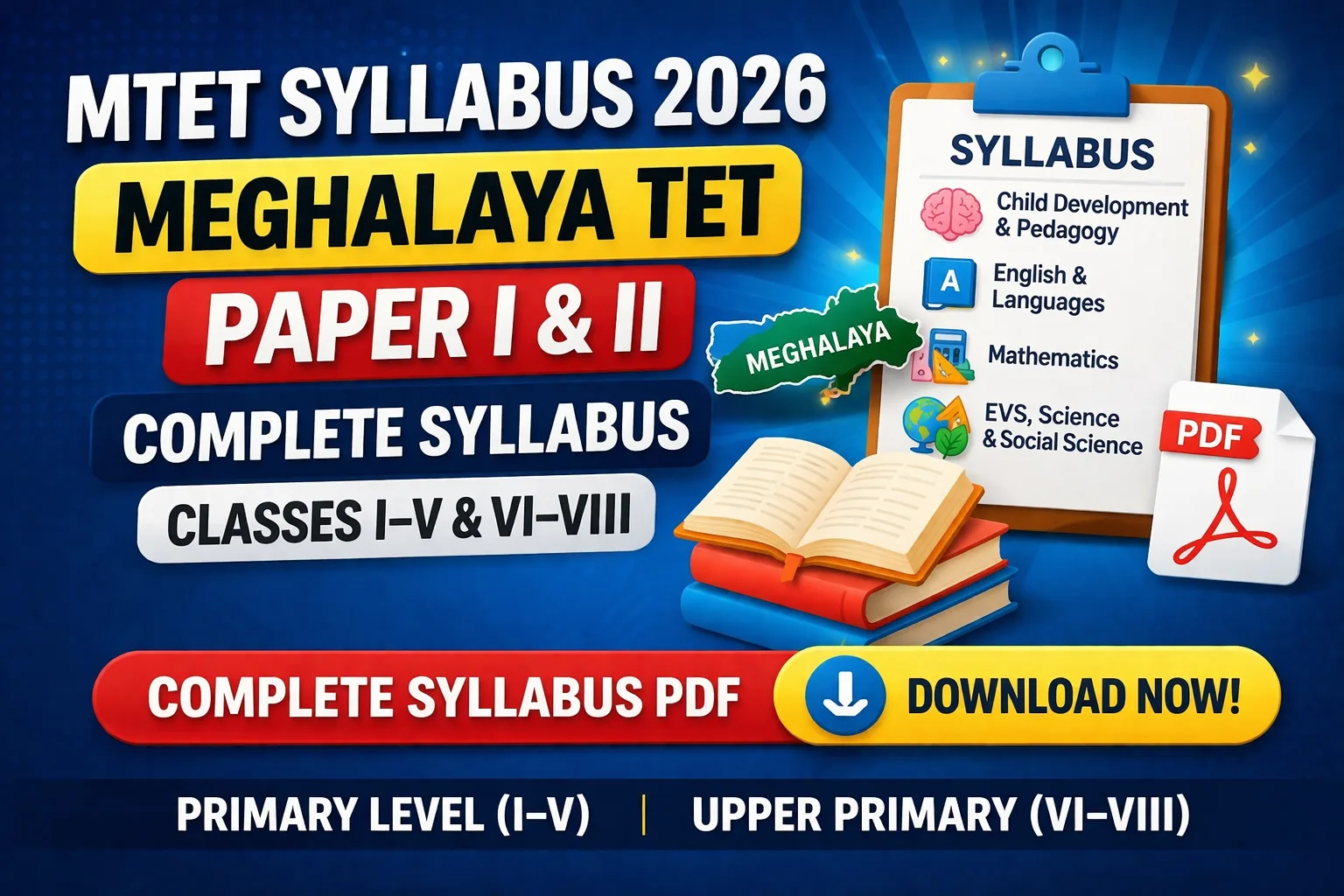
The Meghalaya Teacher Eligibility Test, MTET Syllabus 2026 has been officially designed to assess the knowledge, teaching skills, and pedagogical understanding of candidates who wish to become teachers in Meghalaya.
The syllabus is divided into Paper I (Classes I–V) and Paper II (Classes VI–VIII), covering subjects like Child Development, Languages, Mathematics, EVS, Science, and Social Science.
Apply for MTET 2026: Meghalaya TET 2026 – Apply Online for MTET Exam, Check Eligibility, Dates & Pattern
MTET Syllabus 2026 – Overview
| Particulars | Details |
|---|---|
| Exam Name | Meghalaya Teacher Eligibility Test (MTET) |
| Conducting Body | Government of Meghalaya |
| Papers | Paper I & Paper II |
| Level | Primary & Upper Primary |
| Total Marks (Each Subject) | 30 Marks |
| Mode | Offline / OMR Based |
MTET Paper I Syllabus (Classes I–V)
1. Child Development and Pedagogy
- Concept and stages of child development
- Piaget’s cognitive development theory
- Kohlberg’s moral development
- Inclusive education & CWSN
- Learning theories and pedagogy
- Assessment (Formative, Summative, SBA)
2. English
- Listening & Speaking skills
- Reading comprehension (stories, poems, ads)
- Writing (letters, notices, reports)
- Grammar & unseen passages
- Classroom teaching methods
3. Mathematics
- Number system, fractions, decimals
- Percentage & measurement
- Geometry & patterns
- Data handling
- Teaching methods (games, ICT, problem-solving)
4. Environmental Studies (EVS)
- Natural resources & biodiversity
- Meghalaya environment & culture
- Pollution & conservation
- Teaching methods (activities, field visits)
- Assessment techniques
5. Languages (Khasi / Garo / Hindi / Assamese / Bengali / Nepali)
- Unseen passages & poems
- Reading, writing, speaking skills
- Grammar basics
- Teaching methods & evaluation techniques
MTET Paper II Syllabus (Classes VI–VIII)
1. Child Development and Pedagogy
- Growth & development (childhood & adolescence)
- Piaget & Vygotsky theories
- Inclusive education
- Learning processes & memory
- Assessment & remedial teaching
2. English
- Functional language use
- Reading & writing skills
- Grammar & comprehension
- Reflective practices
- Classroom pedagogy
3. Mathematics
- Number systems, algebra, ratio
- Geometry & mensuration
- Statistics (mean, median, mode)
- Teaching methods (inductive, project-based)
4. Science
- Motion, heat, light, electricity
- Matter, acids, bases
- Plant & animal biology
- Teaching strategies & experiments
5. Social Science
- History: Civilization, Mughal Empire, Freedom Movement
- Geography: Earth, climate, resources
- Civics: Constitution, democracy
- Economics: Banking, sectors, consumer rights
6. Languages (Khasi / Garo / Hindi / Assamese / Bengali / Nepali / Urdu / Mizo)
- Reading comprehension (prose & poetry)
- Grammar & composition
- Teaching pedagogy
- Assessment techniques
Important Features of MTET Syllabus
- Focus on child-centered teaching approach
- Emphasis on inclusive education (CWSN)
- Based on NCF 2005 guidelines
- Covers pedagogy + subject knowledge
- Includes practical classroom strategies
Important Link
| Apply Online for MTET 2026 | Click Here |
| Download Syllabus | Click Here |
FAQs on MTET Syllabus 2026
1. What is the syllabus of MTET 2026?
The syllabus includes Child Development, Language, Mathematics, EVS (Paper I) and Science/Social Science (Paper II).
2. Is MTET syllabus similar to CTET?
Yes, the Central Teacher Eligibility Test and MTET syllabi are quite similar but MTET includes Meghalaya-specific topics.
More Job

NVS Shillong Recruitment 2026 – Teaching & Non-Teaching Posts
April 16, 2026
Navodaya Vidyalaya Samiti, Shillong Region has released a notification for Teaching and Non-Teaching posts on contractual basis in various Jawahar...

Meghalaya MPSC Recruitment 2026 – Apply Online for Tourist Officer & Draftsman Posts
April 8, 2026
MPSC Recruitment 2026: Meghalaya Public Service Commission has invited applications for the recruitment of 03 Tourist Officer & Draftsman Vacancy. Interested...
3. How many papers are there in MTET?
There are two papers:
- Paper I (Classes I–V)
- Paper II (Classes VI–VIII)
4. What is the total marks of MTET exam?
Each subject carries 30 marks.
Central Govt Job

CRPF Constable Recruitment 2026 – Apply Online for 9,195 Posts
April 18, 2026
The Central Reserve Police Force (CRPF) has officially announced the Constable (Technical & Tradesmen and Pioneer) Recruitment 2026. This is...

LIC HFL Recruitment 2026 – 180 Junior Assistant Vacancy Apply Online
April 16, 2026
LIC HFL Recruitment 2026: LIC Housing Finance Limited has officially released a recruitment notification for 180 Junior Assistant posts across...